
A couple of consistent challenges stand out for developers building Agentic applications: the limitations of context window, and the access to updated information out of the default training dataset.
No matter how large the context window becomes, there will always be information that exists beyond their boundaries—current events, emerging data, or specific knowledge that simply wasn’t available during model training. Today, I’m excited to share how the Neuron AI framework is addressing this challenge head-on for PHP developers with its latest addition: web search capabilities powered by Tavily API.
The Information Gap Problem
When we first began developing Neuron, our vision was to create a framework-agnostic solution that would empower PHP developers to build sophisticated AI agents without having to reinvent themselves as Python developers or JavaScript specialists. We recognized that PHP powers most of the web’s backend infrastructure, yet its developer community was being left behind in the AI Agents revolution.
What we didn’t fully anticipate was how quickly Neuron adopters would push beyond basic prompt engineering into more complex agent behaviors. These early users weren’t just building simple chatbots—they were creating customer support agents that needed product knowledge, content assistants requiring up-to-date industry information, and research tools demanding access to the latest available data.
I hope this is the path to establish Neuron and Inspector as a trustable platform for PHP companies to start their journey in AI Agents development with the right foundations.
Connecting Agents to the Web
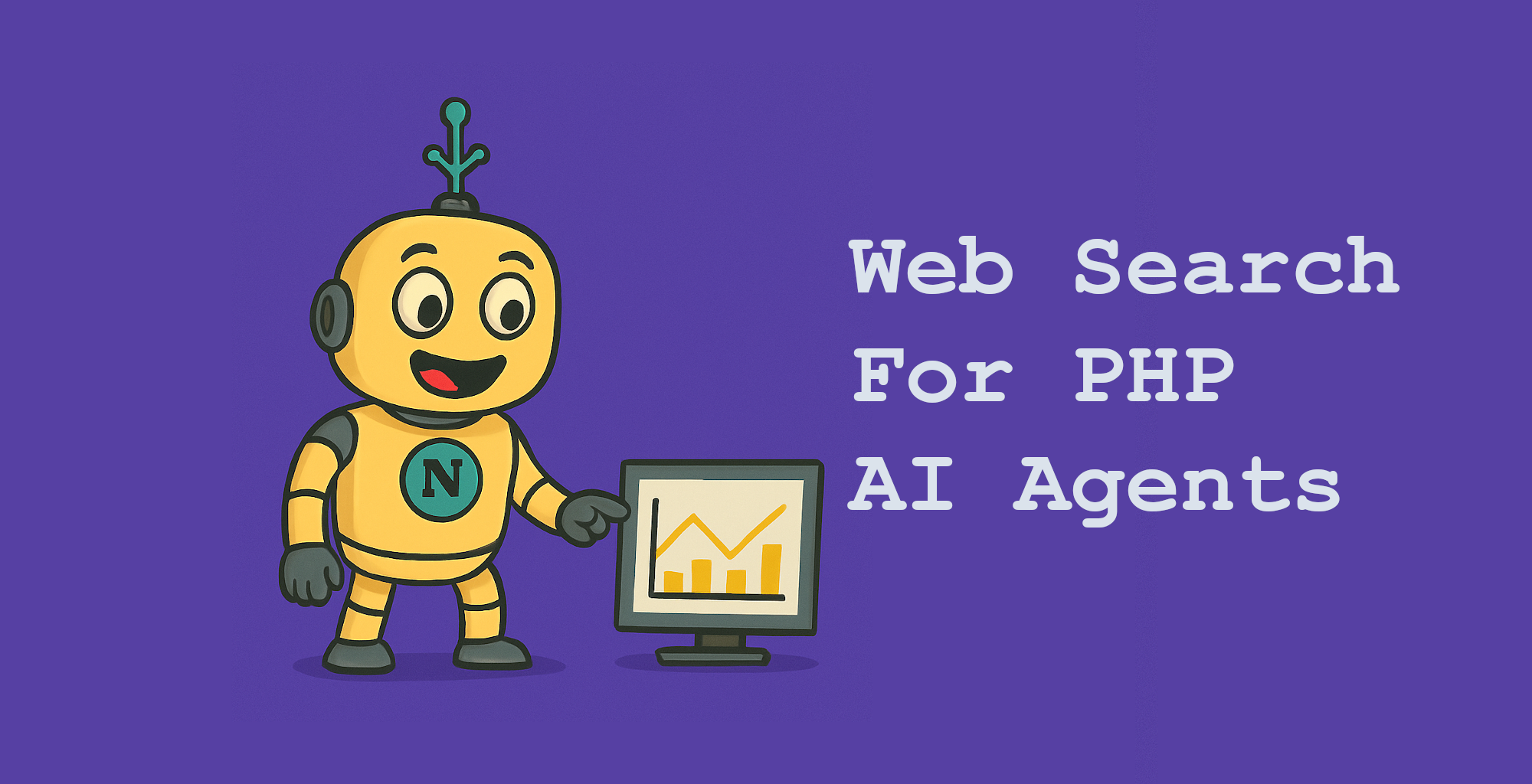
By integrating with Tavily API, a specialized search service built specifically for AI applications, Neuron agents can now dynamically seek information beyond their context windows, or knowledge stored in a vector database, and incorporate this data into their responses.
This integration works through a straightforward Tool component that handles the search workflow—from query formulation to result parsing—while maintaining the clean, object-oriented design principles that define the Neuron framework.
Real-world Applications
A publishing company implemented Neuron agents to help their writers with research and fact-checking. Before integrating web search capabilities, their agents could only offer general guidance based on information available in the model’s training data. After implementing the web search component, these same agents began providing writers with recent statistics, emerging industry perspectives, and verification of factual claims from authoritative sources.
The agents became research partners rather than just writing assistants, leading to more comprehensive, accurate content production without writers having to constantly switch between their AI tool and a web browser.
Another Neuron user, a legal tech startup, deployed agents to help with preliminary case research. By connecting their agents to web search, they enabled their system to pull relevant precedents, recent judgments, and jurisdictional variances that would have been impossible to include in the agent’s base context window or vector store. This capability reduced the time attorneys spent on initial research, allowing them to focus on the strategic elements of their cases.
Framework Agnostic: The Neuron Advantage
One of the most significant advantages of this implementation is that it remains true to Neuron’s core philosophy of framework extensibility and maintainability. Whether you’re building on Laravel, Symfony, or a custom PHP framework, you can attach the web search capability to your agent and run everywhere.
This approach solves one of the most persistent challenges in the PHP ecosystem—the tendency of tools to become tightly coupled with specific frameworks. By maintaining independence from any particular framework, Neuron ensures that your investment in AI capability remains protected regardless of future framework updates or strategic shifts in your technology stack.
The code is structured with clean interfaces and proper abstraction layers, making it not only a useful tool but also an educational example of how to integrate external services with AI agents. This implementation serves as a blueprint for PHP developers looking to create their own toolkits for other external services and APIs.
Enterprise-Ready Reliability
Reliability in production is non-negotiable for business applications, which is why we’ve partnered with Tavily for this integration. As a specialized search API built specifically for AI applications, Tavily provides highly relevant results optimized for AI consumption, with features like content extraction and structured data that make it particularly well-suited for agent workflows.
This reliability extends to the implementation itself. The web search component includes comprehensive error handling, thoughtful rate limiting considerations, and full compatibility with Inspector’s observability tooling, ensuring that your agents’ interactions with the web are as robust as your core application logic.
For more information about AI Agents monitoring check out the documentation.
For those new to AI agent development in PHP, I’ve documented the foundational patterns and progressive implementation approaches in an educational resource that walks through the basic development lifecycle — Start With AI Agents In PHP
How To Use Tavily Web Search
Implementing web search capabilities in your Neuron agents is straightforward by design. The component handles the complexities of API communication, result parsing, and content extraction, allowing you to focus on the agent behaviors that drive value for your users.
The integration requires minimal configuration—just an API key from Tavily and a few lines of code to integrate the search capability into your agent workflows.
use NeuronAI\Agent;
use NeuronAI\Tools\Toolkits\Tavily\TavilySearchTool;

class MyAgent extends Agent
{
    ...

    protected function tools(): array
    {
        return [
            TavilySearchTool::make(
                key: 'TAVILY_API_KEY'
            ),
        ];
    }
}
You can customize the default options to retrieve search results by passing your preference in the withOptions method:
TavilySearchTool::make(
    key: 'TAVILY_API_KEY'
)->withOptions([
    'days' => 30,
    'max_results' => 10,
]),
Conclusion
As we continue to evolve the framework, we remain committed to this approach—practical enhancements that expand capabilities without introducing unnecessary complexity, always with an eye toward production reliability.
For PHP developers who have been waiting for the right moment to incorporate AI Agents into their applications, there’s never been a better time to start building with Neuron. The addition of web search capabilities opens up entirely new use cases, and the framework-agnostic design ensures that your investment will continue to pay dividends regardless of how your technology stack evolves.
The future of AI in PHP isn’t about replacing existing systems—it’s about enhancing those systems with intelligent capabilities that solve real problems.